

- info@womensun.com
- 8:00 - 4:30, Friday & Sunday - CLOSED
Sep
- by admin
- 0 Comments
Final Analysis of the Opinion Poll (The Vocational Training Center)
First: General Reading of the Opinion Poll Results
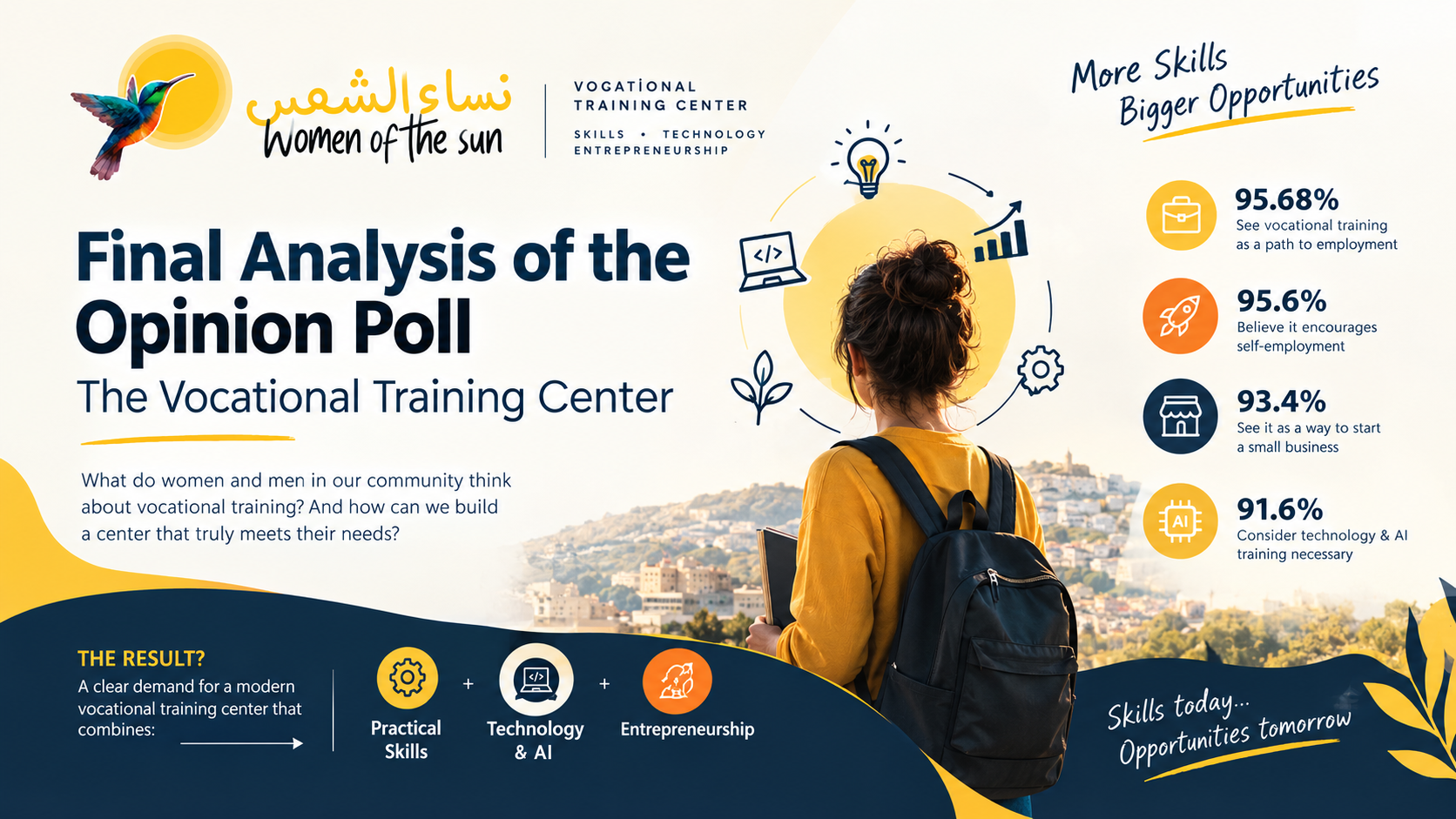
The results show very strong support for the idea of vocational training as a tool for transitioning into employment or starting a small business. The percentage of respondents who agreed or strongly agreed that vocational training increases employment opportunities reached 95.68%. In addition, 95.6% believed that vocational training encourages self-employment, while 93.4% believed that vocational training helps people establish small businesses.
This means that participants do not view vocational training merely as a way of acquiring a skill, but rather as a direct means of employment, entrepreneurship, and improving income.
More importantly, approximately 93.5% of participants agreed that there is a need for new vocational specializations that are compatible with labor market needs. Meanwhile, the percentage who agreed or strongly agreed that training in technology and artificial intelligence is necessary reached approximately 91.6%.
This indicates a clear awareness that traditional vocational training alone is no longer sufficient, and that the new center should combine:
Vocational Skills + Technology + Entrepreneurship
Second: What Do the Participants’ Characteristics Tell Us?
The sample shows a relatively diverse composition in terms of age, location, and educational level. Women represented 77.4% of participants, compared with 22.6% men.
The most represented age groups were 35–44 years, at 29%, followed by 25–34 years, at 25.8%, and 18–24 years, at 21.5%.
Geographically, participants came from cities and villages in relatively similar proportions, with city residents representing 43%, village residents 40.9%, and camp residents 16.1%.
In terms of education, holders of a bachelor’s degree represented the largest group at 46.2%, followed by those with a secondary school education at 20.4%, and diploma holders at 14%.
These results indicate that the center has an opportunity to develop programs at multiple levels, because its target audience is not limited to young people looking for their first job. It also includes adults for whom training could serve as a means of professional retraining or transition to self-employment.
However, there is an important observation: the relatively high percentage of bachelor’s degree holders means that the center should not present itself merely as a traditional vocational training center. Instead, it can distinguish itself as a center for “modern vocational skills” that combines practical skills, digital knowledge, and entrepreneurship.
Third: The Strongest Result in the Poll: Technology Is No Longer an Option
One of the most important findings is that 66% strongly agreed that training in technology and artificial intelligence has become necessary, in addition to 25% who agreed with this statement.
This result has significant strategic implications.
The objective does not necessarily need to be to establish a center that teaches technology separately from vocational professions. Rather, technology can be integrated into every profession.
For example:
- Fashion Design + Digital Design + Digital Marketing
- Handicrafts + Digital Photography + E-Commerce
- Recycling + Design + Marketing
- Wooden Product Manufacturing + CNC
- Device Maintenance + Programming
- Small Businesses + Artificial Intelligence
- Traditional Crafts + Building a Digital Brand
In this way, the center becomes different from a traditional vocational training center.
Fourth: Analysis of the Proposed Specializations
The proposed professions can be divided into three strategic groups.
High-Attractiveness Professions
Recycling and reuse received 56.92% interest, consisting of 40.8% who were interested and 16.12% who were very interested.
Application design and programming also received a total interest level of approximately 65.5%, while artificial intelligence received approximately 59.1%.
E-commerce achieved one of the highest levels of interest, with the percentage of participants who were interested or very interested reaching approximately 66.65%.
Conclusion
There is a clear trend toward professions that can generate independent income without requiring a traditional job.
This is highly important for the vocational training center, because training should not end with the statement, “I learned a profession.” Rather, it should lead to the ability to transform that profession into an economic opportunity, income-generating activity, or small business.
Fifth: Fashion Design Is More Than Just a “Profession”
Fashion design achieved an overall interest rate of approximately 64.4%, which is a high percentage compared with several other craft-based professions.
However, the more strategic interpretation is that fashion design can become a comprehensive economic program, rather than simply a sewing course.
The program could include:
Pattern Making → Sewing and Design → Product Development → Photography → Marketing → Sales
This transforms training from an individual skill into a complete economic value chain.
Sixth: Digital Professions Represent the Clearest Gap
When participants were asked about the skills required in the labor market that are not sufficiently available through current training programs, the following results emerged:
- Artificial Intelligence: 16.8%
- Digital Marketing: 15.6%
- E-Commerce: 13.25%
- Handicrafts: 13.2%
- Fashion Design: 10.8%
- Device Maintenance and Programming: 9.6%
This may be one of the most important findings for defining the identity of the center.
It does not merely answer the question:
“What do people want to learn?”
It answers an even more important question:
“Where do people perceive a gap between the skills required and the training programs currently available?”
The largest gap appears to be in digital skills linked to employment and income generation.
Seventh: There Is a Difference Between “Interest” and “Employment Opportunity”
This is a very important analytical point.
Some professions received high levels of interest. However, when participants were asked which profession they believed offered the best opportunity for employment or starting a small business, the following choices emerged:
- Fashion Design: 9.67%
- E-Commerce: 9.6%
- Digital Marketing: 8.6%
- Beauty and Cosmetics: 6.4%
- Recycling: 5.37%
- Ceramics: 5.37%
- Maintenance and Programming: 5.3%
This suggests that the center should distinguish between what attracts participants and what they believe can generate employment or income.
Therefore, the design of training programs should consider both dimensions: participant interest and perceived economic opportunity.
Eighth: The Result Related to the Preferred Training Method Is Highly Significant
When participants were asked about their preferred training format, the results were:
- Training combining vocational skills, technology, and entrepreneurship: 32.6%
- Theoretical and practical training: 29.5%
- Primarily practical training: 28.4%
A clear message emerges from these findings:
The best model for the center is not simply a “vocational course.”
Rather, it is:
Professional Skill + Technology + Entrepreneurship
In other words:
Vocational Skill + Technology + Entrepreneurship
Ninth: Proposed Training Duration
Participants clearly preferred training programs lasting one to three months, at 38.9%, followed by programs lasting 3–6 months, at 33.7%. Only 13.7% preferred programs lasting less than one month.
Conclusion
There is a suitable opportunity to adopt a model based on:
An 8–12 Week Training Program
with the possibility of offering advanced 3–6 month programs for professions that require deeper training.
It would also be preferable for the program not to be based solely on lectures, but rather on producing a final product or completing an applied project.
Tenth: What Do the Results Tell Us About the Identity of the Center?
When the results are considered together, the opinion poll does not simply say:
“People want to learn professions.”
It says something deeper.
There is a demand for skills that can be transformed into employment, a business, or a source of income, provided that these skills are connected to technology, the market, and entrepreneurship.
This is a highly important strategic point for the Vocational Training Center of Women of the Sun Association.
Therefore, the identity of the center could be:
“A Modern Vocational Training Center Connecting Skills with Technology, Entrepreneurship, and Employment Opportunities.”
Rather than simply being:
“A Center for Teaching Vocations and Crafts.”

